Saint Paul's Best Bat Removal
We've been voted Saint Paul's best bat removal company the past two years!
Get in touch
Bat Experts
Rapid Response
Trained & Educated
Licensed & Certified
About Saint Paul Bat Removal
Welcome to saintpaulbat.com. We are the only qualified bat removal company in Saint Paul, Minnesota. Whether it's one or an entire colony, if you've discovered bats in your metaphorical, or even actual, belfry, don't try and remove them yourself. Bat removal should be handled by the experts with the tools and training to safely remove the bats without risk to themselves, the homeowners, or the bats. We care about all three, of course, and that's why we are dedicated to ensuring the careful and safe removal of bats from your home. You might think that getting rid of bats is easy, but they can be jittery and delicate animals. Since they're basically flying puppies, this makes sense. So if you have bats somewhere you don't want them, don't try to remove them yourself. You may end up hurting the bats and exposing yourself to danger. It's rare for bats to carry rabies, but they can, so don't try and rid your home of them yourself. Call the experts with the training and skills to safely remove them. Bats are good, as long as they're not in your home. We want the bats to be good again, so please, give us a call so we can handle your bat removal needs. We want your home bat free as much as you do, so we'll handle the delicate work so no one get's hurt, including the bats. That way the bats can live their lives, and so can you. A bat free home is best for everyone, after all, including the bats. So let us do the work, so you can stay safe. We operate 24-7-365, so don't hesitate to call us at 651-427-0509 to discuss your bat problem and schedule a fast appointment.
Residential
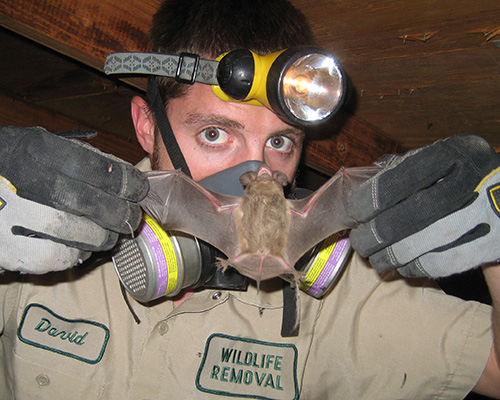
We are experts at removing bats from residential properties. Whether you have a single bat trapped in your house, a colony roosting in your attic, and/or various other problems, there is no need to worry! During our removal process, we make sure to inspect your entire home carefully, tracking down all the entrypoints bats are using to invade your place. Next, we perform a process called live exclusion (where no bats are harmed and all exit your property), then seal all entry holes completely shut. We also take care of the cleanup process after, so your home is safe and clean!
Learn MoreCommercial
Besides residential areas, we also have a wealth of experience removing bats from commercial properties! We begin by investigating the area for possible bat entrances, covering holes even as small as 1/4 of an inch. Through our live exclusion process, bats leave the building through one-way exits, and we seal up every hole afterward. Once the bats have been removed, we perform a cleanup process. This includes dealing with guano, replacing damaged insulation, and decontaminating the place.
Learn More
Contact us for bat removal today!
What Our Customers Say
I had a bat flying around in my house at 9pm, and CITY bat removal came right out and caught it in a net.
Sarah Lakewood
I had an annoying colony of bats stuck in my attic for a while before I finally decided to call for help. They were able to quickly and thoroughly solve the problem!
Brandon Chung
They did a great job clearing my attic of bats and didn't hurt any of the creatures.
Charlotte Demers
The technicians at CITY Bat Removal are skilled, professional, and know exactly what they're doing. Would highly recommend.
Mark O'Connor
My house stank of bats and their guano inside my wall. CITY Bat Removal not only removed the bats, they also got rid of the smell!
Alexis Ramirez
.jpg)
What is a bat's mating habits?
In order to better understand an animal, you need to learn more about what it does, and how it acts in order to survive. While for some, such a lesson may prove scary, it is in fact meant to have the opposite effect. Learning about a commonly feared creature helps you fear it that much less, which is why we're learning more and more about bats. The large majority of people tend to be terrified of bats, both those you find in your attic, but also those you see high up when visiting a cave. These winged little rodents, while chiefly non-aggressive, can give you quite a fright, which is why so many people are terrified of them.
But perhaps, if you got to know them a little better, you wouldn't be. So let's talk a bit about how bats reproduce, shall we?
Of course, in talking about bat reproduction, we can only offer general facts and truths about the bat, as an animal. At present, there are over 1,000 known different species of bats out in the world, and each one of those has its own, particular mating habits. These are often influenced by whether they dwell in rural or urban areas, the climate they inhabit, and so many other different factors. So if you're looking for information on a specific type of bat, we urge that you do more research on that specific species. But for now, let's look at some general bat mating facts.
Bat Mating and the Weather
As with many other creatures, bats' habits are quite heavily influenced by the weather. A female bat will usually mate in the summer, to ensure that she has enough resources throughout her gestation period. As with most creatures, it's harder for bats to find food during the cold, winter months, and so pregnancy can be that much more difficult during that time.
The type of climate a bat lives in will heavily affect its mating habits. For example, if the bat in question lives in a fairly temperate climate that experiences all four seasons roughly the same, the bat will give birth during the summer, to ensure the proper development of the bat embryo.
Other types of climates can be more versatile. Harsh weather, for example, can rarify a bat's mating habits to a certain extent, whereas tropical, Equator climate can mean that the bats in that region reproduce more rapidly. Since the weather is warm for longer periods, there is an abundance of insects and other edibles for the mother bat to feed on during gestation. So this makes it easier for the bat to carry more pregnancies to term at a quicker rate.
Mating Habits
Bats become sexually mature at about 14 months, though this period will depend on the particular species. Bats copulate both at night and during the day (though more frequently in the nighttime). They're fairly promiscuous creatures and don't have the concept of a family unit, copulating with a large number of different bats.
During the day, the male bat will rub its head against the female to copulate, whereas, during the night, it will bite her on the neck to wake her, and then copulate. Like snakes, female bats can store sperm in their reproductive tract for a while, waiting for better weather and more food (which would allow them to better develop the embryo). To give birth, female bats congregate in colonies (often referred to as maternity colonies), primarily during the summer.
While a baby bat is born blind and fairly helpless, it develops rapidly and is pretty much fully independent after about two months. It's around this age that a bat will leave its mother and venture out into the world on its own.